Thursday, November 7, 2013

‘Breaking Boundaries’ Dance Concerts evoke numerous emotions


SAN DIEGO – Some “Breaking Boundaries” dances have been controversial, others sentimental, and still others have interpreted historical events through movement.  Whichever category they fall into, says Dance Department Chair David Mullen, “the student-choreographed dances never fail to evoke a response from our audiences.”

Mullen, who has been involved with 15 annual “Breaking Boundaries” presentations, says he anticipates that audiences will be similarly stimulated at the 7:30 p.m. shows November 14, 15, and 16 at the Joan B. Kroc Theatre at 6611 University Avenue.

Kathy Meyer, who co-directs the student-choreographed show, explained that “Breaking Boundaries”  during the Fall Semester and the faculty-choreographed “Entrances and Exits” in the spring semester provide practical experience for students contemplating careers in dance choreography.

“Students often begin the seed of a dance in a choreography class, which they further develop for the fall concert,” she said.  “As co-directors, David and I mentor the students and regularly attend rehearsals to guide them through choreographic blocks as well as compositional problems.

“It is not our mission to alter the intention of the piece but rather to assist in crafting and guiding the students to help them achieve a more polished piece of choreography,” Meyer added.  “It is so rewarding to see students who begin the process with an idea but have difficulty in plowing through the problem areas, and with a dialog of questions and suggestions  the students often create work in which we are all very proud.”

As in past years, Mullen said, many of the dances to be presented in the 90-minute program will trigger strong emotions.  For example, this semester co-choreographers Nicole Tyer and Alysha Robinson have created a dance that harkens back to the large Cedar fire of 2003 in which 15 persons died and 2,820 San Diego County buildings were burned.  Poignant moments from the Cedar fire are incorporated into the dance, including the images of individuals returning to the site of their destroyed homes in the desperate hope that at least some mementos of their former lives still remain among the rubble.

“Given the fact that virtually everyone in San Diego County has either experienced the fire first hand or has known somebody who has experienced the fire, I think the dance will have quite an impact,” said Mullen.

Recalling other dances that have shocked or resonated with audiences over the past 15 years, he mentioned one choreographed by Christopher Enders that protested Proposition 8, the decision by California voters to ban same-sex marriages.  Enders response was to create a dance of anger and protest which portrayed graphic images of sexuality, politics, and religion. 

While controversial, the dance neither included nudity nor foul language, Mullen recalled.  To those who were offended by it, he explained that  art is often used as social commentary, and that it was neither his nor his co-director Kathy Meyer’s job to censor opinions but instead to defend and support  students’ rights  as artists to portray those feelings through the medium of dance.

Another past dance that came to Mullen’s mind was one by Nicole Chandler, in which the student paid tribute to her late father.  An image of her father was projected onto a back wall, and “she began her dance to a spoken text that she had recorded about her memories of him.  The dance that followed was all done in white; the dancers were very angelic and the movement was flowing, reflecting the music.  It was a very moving, and beautiful piece.  I had lost my own father a few years prior, so it was very moving to me.”

Mullen said he is often amazed by the variety and depth of student choreography, and says the concert with 12 different dances – the longest lasting  6-7 minutes—will keep audiences well entertained at the upcoming “Breaking Boundaries” presentation. Tickets are $10 in advance of the show via telephone (619) 644-7766 and $13 at the door.

--DHH-


Tuesday, November 5, 2013

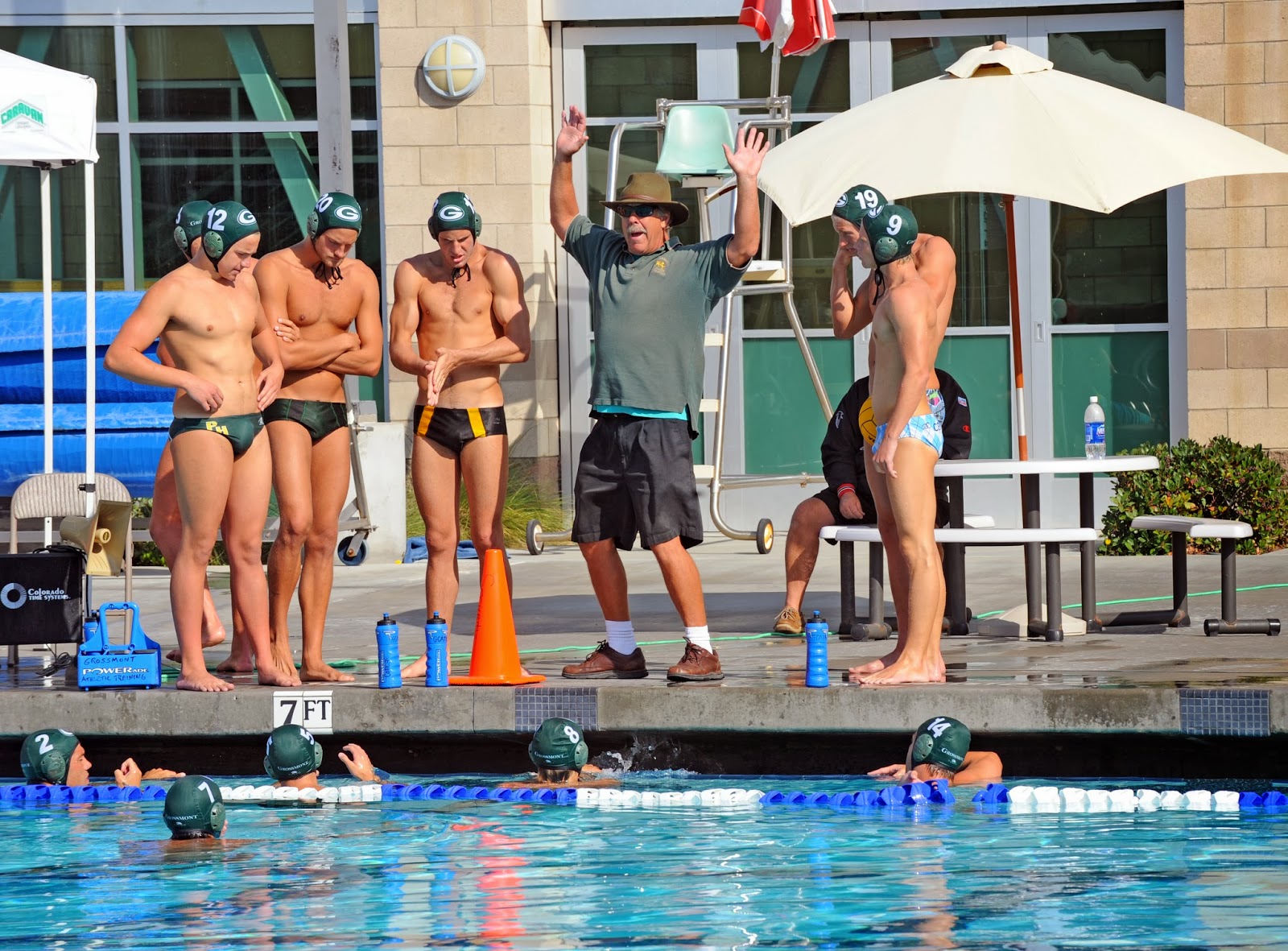
Grossmont College Coach Seeks Team Championship and Career Win No. 606


Coach Brian Harvey offers some pointers on blocking


EL CAJON—Grossmont College will seek its 20th men’s water polo championship and its coach Brian Harvey will be shooting for Career Wins No. 605 and 606 at Miramar College on Friday and Saturday during the championship rounds of the Pacific Coast Athletic Conference

On Friday, Nov. 8, Grossmont will draw either Southwestern College or Miramar College as an opponent, and should the powerhouse Grossmont team win, as expected, it will play in the championship game on Saturday.  Harvey predicts his team’s opponent for that contest will be San Diego Mesa College, which last Wednesday fell 12-8 to the Griffins and gave Harvey his 600th career win.  Since then his team won four more games during a tournament held at Saddleback College.

Over his 25 years as a water polo coach for Grossmont College,  Harvey has compiled a record of 604 wins and 226 losses for a .727 winning percentage.  His team won its first conference championship in 1990 against Orange Coast College in a 12-0 season, and then dominated the Orange Coast Conference through 1998 and the Pacific Coast Athletic Conference thereafter.
For Harvey, it is easier to remember the seasons when Grossmont College didn’t win the championship as opposed to the other way around.  In 1999, he said, the team shared the championship, and was runner up in 2010.  In all the other years, his team won the championships – the reason why  it is Number One Seed in the finals starting this Friday.

Some of the most memorable moments of his career came in 2007, “when we won the championship with seven-tenths of a second to go,” and in 2010 “when we lost the championship with three-tenths of a second to go.”

Over his career, said Harvey, he has produced “45 All-Americans so far.”

What makes Harvey’s achievement all the more remarkable is that Grossmont College does not have a regulation size pool, so much of the team’s training, and all of its so-called “home games” must be played in other swimming pools.

“I think I have rented every swimming pool in the county at one time or another,” Harvey said.
Currently the team trains at night at Granite Hills High School 50-meter swimming pool.  Although there is a swimming pool on the Grossmont College campus, it is “too short, too narrow and too shallow” for water polo, and therefore is only used for leg conditioning and passing and shooting drills.  He compared using that pool to playing half-court basketball.

So what is Harvey’s secret?  Why have his teams dominated the league year after year?

As a coach, he treats his players with respect.“I always try to be positive with my players rather than yelling or being negative,” he said.  “I also leave a lot of the decision-making with my players.”  Furthermore, he said “there is a sense of humor that goes into this. We have fun, it has to be fun.”
Furthermore, "a lot of our practices are goal-oriented meaning that once you achieve the goals stated for a particular skill or drill, the team moves on to the next.  The better the performance, the quicker they move to the next skill."

Harvey also credited Jim Spillers, Grossmont College’s associate dean for athletics, with providing unfailing support for the team.  “He is a pleasure to work with,” Harvey said.

Harvey’s own water polo career started at Cerritos College, and then continued at Cal State Fullerton and Cal State Long Beach.  He played as a two-meter guard and a sprinter.

-DHH-

Monday, November 4, 2013

California must produce 2 million more college graduates by 2020

EL CAJON – California will need to grant 2 million more bachelor’s degrees by 2020 if it is to meet the needs of its economy, says Assemblywoman Shirley N. Weber (D-79), who chairs the Assembly’s Select Committee on Higher Education in San Diego County. 

She told attendees of a luncheon held Thursday, Oct. 31, at Grossmont College that if California is to meet that goal, it must greatly increase the number of students who enroll in college and complete their courses of study. 

In order to do that, she added, institutions of higher education must attract and retain more students from minority communities, especially from the under-represented African-American and Hispanic communities.

Diversifying the student population and increasing job opportunities for all California citizens not only is morally right, it is economically right, said the Assemblywoman.

Scheduled to deliver an 11 a.m. speech November 7 to Grossmont College’s student body on “Higher Education in a Diverse Society,” the Assemblymember met ahead of time with approximately two dozen administrators, faculty and students to exchange ideas.

Assemblymember Weber, who had served previously as a board member of the San Diego Unified School District as well as a professor at San Diego State University, said she has read studies indicating that students who go to pre-school have a greater chance of making successes of their lives than those who do not.    Pre-schools help children prepare to take their places in society, she said.  If you want to prevent children from growing up to become criminals, she advised, “send them to preschool.”

Another important step is to remove barriers to completing higher education, Assemblymember Weber said. Students who graduate from community colleges, like Grossmont College, should have the opportunity to complete their educations in the California State University system, she said.  She noted that a legislative hearing on improving college access and completion rates will be held at Crawford High School in San Diego on November 21st.

The Assemblymember also shared the fact that ethnic studies have come under increasing attack in the State from those who feel they do not impart any useful skills.  She said she was able to persuade both houses of the California Legislature to place a moratorium on any efforts to shut down ethnic study programs until an impartial study can be conducted to determine what they contribute.

From her own experience as a faculty member, Assemblymember Weber said she knows that such programs are places where students of various backgrounds can find faculty members who understand them and encourage them—important factors in aiding more students from minority communities to be successful in their studies, to graduate,  and to enter the degree-holding workforce.

The Assemblywoman suggested that colleges and universities find ways to incentivize faculty members to become mentors to members of their own minority group. “If you are the only one in your family who has attended college, you need mentors,” she said.


-DHH-

Native American actor urges retention of traditions

Saginaw Grant


EL CAJON—Actor Saginaw Grant, a Sac and Fox Indian who has played numerous Native American roles in the movies and on television, said at a Student Veteran Organization event at Grossmont College on Monday, Nov. 4. that every combat veteran comes home with hidden wounds caused by the things they saw or did.  However, he said, it’s important that they banish negative thoughts from their minds: “You can’t change those things by thinking about them.”

Grant, who had served in the Marine Corps during the Korean Conflict, said even after separating from the military service, veterans should continue to honor the proud military traditions that have been passed down for generations. Likewise, Grant, who appeared in the 2013 movie The Lone Ranger as the Comanche Chief Big Bear, said that his Indian people should carefully listen and then honor the lessons that have been transmitted  for eons in their oral traditions.

His fellow Marines value being on time and being able to listen, he said.  They also conduct themselves with pride, no matter how harshly life might deal with them.

His Sac and Fox people value the gifts given to them by the Creator. They welcome back the sun every morning, knowing how good it feels to be greeted at home following a journey. He said he personally thanks the Creator for letting him feel well, for the meals that he eats, and for letting him see the sky.  He added that he asks the Creator to let him show kindness to other people, and to demonstrate how friendly he can be.

In former days, he said, Sac and Fox grandchildren listened to the elders tell them about life, but today some are not interested in hearing. Some don’t show respect for elders. 

Likewise, he said, continuing in his theme of parallelism, some people don’t show military veterans the respect they are due for having volunteered to go into combat. 

This culture of disregard also extends to Mother Earth, from which people have taken so much—coal, oil, different minerals.  At the pace mankind despoils the earth, it will not last another four generations, he said.

He said his people traditionally believe that humans and animals once had the ability to speak to one another, but that animals withdrew themselves from the relationship because humans abused them.  However, animals still are willing to teach by example.  “Animals know more than we do about the weather, and about treating each other right,” he said.

Grant expressed hope that traditions and civility can be reclaimed because both provide life with its richness.  It was the culture of giving that prompted American Indians in Massachusetts to greet the Pilgrims, to provide them with fresh water and food, he said. 

He urged students who gathered in the Main Quad of Grossmont College to hear his address to find what they are good at, and then to develop that talent.  “When you do that you will find satisfaction,” he said.  “We have a purpose.”

The actor and lecturer concluded his speech with a story about the Creator coming down to see his work and meeting a dog and a turtle. He instructed them to proceed from where they were standing to the base of a tree on the top of a mountain off in the distance. The dog dashed to the destination, whereas the turtle took his time, three moons in fact.  The Creator asked the dog what he had seen along the way.  The dog responded he hadn’t really seen anything, he was so intent on getting there. When the turtle arrived, it took him four moons just to tell all the wonders he had witnessed along the way.

“You must take your time in life to enjoy your life,” Grant advised.  There are things that are beautiful to be enjoyed, he said.  “Enjoy your lives.”

Jason Diaz, vice president of the Student Veteran Organization, said other veteran events are planned throughout the week.  The schedule is as follows:

Tuesday, Nov. 5, a Veterans Resource Fair will be held on the Main Quad, with photos of veterans in uniform being collected for a future mural. 

Wednesday, Nov. 6: Screening in Griffin Gate at 11 a.m. of the movie The WindTalkers, followed by a talk by Ivan Sam, grandson of one of the original Code Talkers of World War II.  That same day, there will be a Self Defense Seminar at the athletic fields. 

Thursday, Nov. 7:  Veterans Art Expose and the screening of Grossmont’s own produced movie, Bringing It Home  from 2-5 p.m. in Griffin Center.  Panda Express in the Grossmont Shopping Center will participate from 11 a.m. to 8 p.m. in a fundraiser for the SVO. 

Friday, Nov. 8: Rubio’s in the Grossmont Shopping Center will participate in another SVO fundraiser.

-DHH-


Friday, November 1, 2013

Nov. 4-8 Political Economy Week features diverse speakers


EL CAJON, California -- "Political Economy Week" sponsored by Grossmont College's Political Economy Department, is intended to "facilitate a close examination of the political and economic issues impacting our local, national and international communities," according to Todd Myers, the department chairman.

"The faculty of the department share their own political opinions and involvement with the students, while also presenting speakers representing diverse viewpoints."

Here is the Nov. 4-8 lineup including times and room assignments:

Monday, November 4th

8:00 – 9:15 Room 578 Does the ascent of women mean the decline of men? with Joe Braunwarth.

9:30 – 10:45 Room 579 The Politics of Border Security and Immigration with Rumman Chowdhury.

11:00 – 12:15 Room 575 Conservative versus Liberal Debate with Will Cummings and Scott McGann.

12:30 -1:45 Room 575 Sustainable Economies and the Environment with Shahrokh Shahrokhi.

12:30 – 1:45 Room 577 The Economics and Politics of Holding the U.S. Government Hostage with Will Cummings.

2:00 – 3:15 Room 581 Civil rights on the 50th anniversary of the March on Washington with Joe Braunwarth.

5:30 – 6:45 Room 577 The New Geopolitics of Nuclear Weapons with Ron Bee.

Tuesday, November 5th

8:00-9:15 Room 579 The Great Depression vs. the Great Recession with Scott McGann.

9:30-10:45 Room 325 The Affordable Care Act and the Republican Party with Joe Braunwarth.

9:30-10:45 Room 577 TedTalks and Solving Global Problems with John Mercurio.

11:00-12:15 Room 575 The Economics of Happiness with Shahrokh Shahrokhi and Todd Myers.

11:00 – 12:15 Room 522 What has the Recession done to Millennials? with Joe Braunwarth.

12:30-1:45 Room 575 Bleeding Heart Libertarians: Free Markets and Social Justice with Matthew Zwolinski, Professor of Philosophy at the University of San Diego.

2:00 – 3:15 Room 577 Current Negotiations in Israel and Palestine with Lori Carrillo.

Wednesday, November 6th

9:30-10:45 Room 579 Gold, Stock, Cash; The Macroeconomics of Investing with Scott McGann.

11:00 – 12:15 Room 575 Health Care Debate with Scott McGann and Greg Robinson.

12:30 -1:45 Room 575 Will a War between Buddhism and Islam Erupt in Southeast Asia? with Todd Myers.

2:00- 3:15 Room 581 Should the United States Have a Non-interventionist Foreign Policy with Todd Myers.

2:00 – 3:15 Room 583 From Freedom to Slavery: Doublethink vs. the Liberal Habit of Mind with Ivo Gatzinski.

5:30-6:45 Room 535B Market Fundamentalism and Financial Instability with Shahrokh Shahrokhi.

7:00 – 8:15 Room 579 The New Geopolitics of Nuclear Weapons with Ron Bee.

7:00-9:30 Room 575 Amazing Grace film and discussion about the struggle against slavery with the Young Americans for Liberty.

Thursday, November 7th


8:00 – 9:15 Room 579 Housing Bubble and Financial Crash of 2008 with Scott McGann

9:30-10:45 Griffin Gate They Poured Fire on Us from the Sky with Alepho Deng and Judy Bernstein.

11:00- 12:15 Griffin Gate Meeting with California Assembly Member Shirley Weber

12:30-1:45 Room 575 Economics of Health Care with Shahrokh Shahrokhi.

12:30 –1:45 Room 577 Chaos: Economic Armageddon: Somalia, Chad, Detroit and Other Failed States-- film and discussion with Will Cummings

2:00 – 3:15 Room 577 Economic and Political Impacts of Medical Marijuana Laws in San Diego with Lori Carrillo.

3:30-4:45 Room 575 Bitcoin: a New Currency for a New Digital Age with Chris Cross.

Friday, November 8th

9:30-10:45 Room 575 Inside Job – Academy Award Winning Film about the Financial Meltdown of 2008 with Will Cummings.

Assistive Technology exhibit planned Nov. 7 at Grossmont College

EL CAJON—Students in Grossmont College’s occupational therapy assistant program will demonstrate devices that they invented to assist friends and family members with disabilities, at the annual Assistive Technology Show to be held from 6:30 p.m. to 8 p.m. on both levels of the Health Science Building on Thursday, Nov. 7.

Over the years, there have been some pretty ingenious devices developed, according to instructor Darlene Cook.  For example, there was a device that attached to the front of a wheelchair that allowed a disabled person to push her child’s stroller in front of her.

The stroller was attached facing the wheelchair so that the mother could reach over from her sitting position and feed, pick up or play with the baby, said Cook.  Another invention, also designed for use by a person bound to a wheelchair, was a flexible broom.  Because the broom would bend, the user was able to sweep the floor from her wheelchair.

Another of Cook’s favorites was a device enabling a person who couldn’t grasp a hamburger for very long to keep it within biting distance through the use of a sleeve through which the burger could be pushed into his mouth.

Yet another  invention helped a man with hyper-extended fingers to use a computer mouse. The occupational therapy asssistant student separated the mouse into two portions – so that the track ball could be used with one hand, and the clicker with the other.

The man for whom it was developed was so taken with the invention that he exclaimed upon using it, “Now maybe I can get a job!” Cook recalled.

In another instance, a magnetized device helped a woman who has use of only one hand to put on her earrings.

This year, said Cook, 20 students will preview their inventions.  The devices not only are important to the people for whom they are designed; they also “give our OTA students confidence that they can solve problems,” she said.

Over the six years she has been teaching the course, 100 percent of her students have been able to develop assistive technology devices for their family and friends. Better yet, they have been able to do so inexpensively because one requirement of the exercise is to keep the cost below #10 by using everyday materials.

###